


AFCC's
2026
Farm Bill Initiatives

Click on the links below to view the articles in The Digest
describing AFCC's progress
in carrying out its 2026 Farm Bill Initiatives



By Ramani Narayan
AFCC Advisory Board Member
Special to The Digest
Words are the building blocks of public trust.
Yet, deep within the machinery of the 2026 Farm Bill, a seemingly minor provision threatens to muddy the waters. Section 9004 in Energy Title IX, attempts to redefine the term "bio"-a move that may sound like inside-the-Beltway semantics, but one that has the potential to fundamentally alter how every American shops.
The Loophole: "Bio-Attributed" vs. "Biobased" However, the current wording of Section 9004 introduces a deceptive loophole. It allows manufacturers to label products as "bio-attributed" or "biobased" simply because agricultural (bio) materials were used somewhere in the supply chain -even if that final product contains absolutely zero biological material (zero bio carbon content). There is a fundamental difference between the process of manufacturing and the ingredients of the final product:
Manufacturing Inputs: Heat, energy, binders, and chemical reactions used to convert raw materials.
Final Product Ingredients: The actual physical matter that a consumer takes home.
The Core Problem: Under the proposed wording, a purely fossil carbon containing plastic product with zero physical bio (carbon) content could legally be labeled "bio-attributed."
In the August 5, 2026 Digest, more background on the Biop-Attributed Loophole, Undermining a Proven Standard, BioPreferred Metrics current scope — advocating to let science dictate the label — as Michigan State University Distinguished Professor and founding Chair of ASTM subcommittee D20.96, Ramani Narayan, takes us through the upcoming Farm Bill changes and the Bio-Attributed Loophole — ready for you now at the Digest online.
To download and view a PDF of the article, click here.
Click here to download and view AFCC's
Strike and Replace Language
for Section 9004 in the 2026 Farm Bill
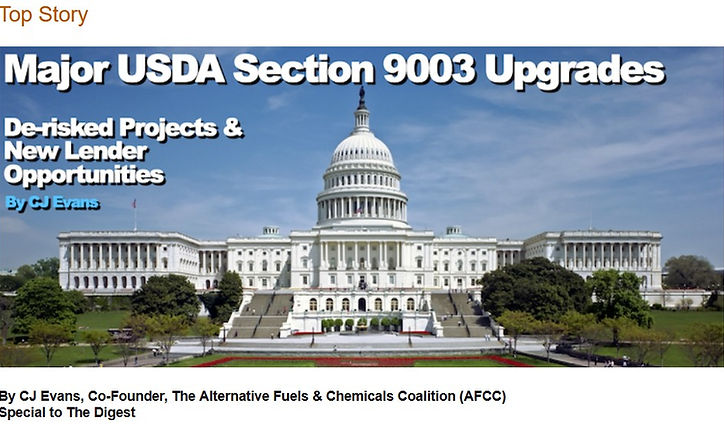
For over two decades, the United States bioeconomy has possessed the technological ingenuity to replace fossil-derived fuels, chemicals, and products, revitalize rural economies, establish domestic energy independence, and challenge global competitors for energy dominance. Yet, a persistent and formidable barrier has stood between groundbreaking laboratory innovations and commercial-scale production: the infamous "Valley of Death."
Navigating the transition from a pilot plant to a commercial facility requires a massive investment of private capital. Since 2005 and 2008, this burden has been shared by two federal loan guarantee programs:
-
The U.S. Department of Energy’s Title 17 Loan Guarantee Program
-
The U.S. Department of Agriculture’s (USDA) Section 9003 Biorefinery, Renewable Chemical, and Biobased Products Manufacturing Assistance program.
While both programs were conceived as financial bridges, the Section 9003 program has faced severe bottlenecks. Historically, the program's success rate has been minimal, with its last commercial loan closing occurring in December 2020.
Lenders and borrowers have struggled to close deals primarily because very few developers possess the upfront capital required to fund the Integrated Demonstration Unit required by the Section 9003 program. Recognizing these structural flaws, the Alternative Fuels & Chemicals Coalition launched an aggressive advocacy campaign to reform the program.
In the July 14, 2026 Digest, DC guru CJ Evans assesses dismantling the IDU Bottleneck: A Permanent Solution, The Evolution of IDU Funding, Expanding the Cap and Unlocking Private Capital, Bridging the "Lender Exposure" Gap, The Road Ahead: Budget Realities and National Security Imperatives, and more, ready for you now at The Digest online.
To download and view a PDF of the article, click here.

For more information on AFCC's advocacy efforts and how you can support and benefit from these efforts, please use the contact form below.